
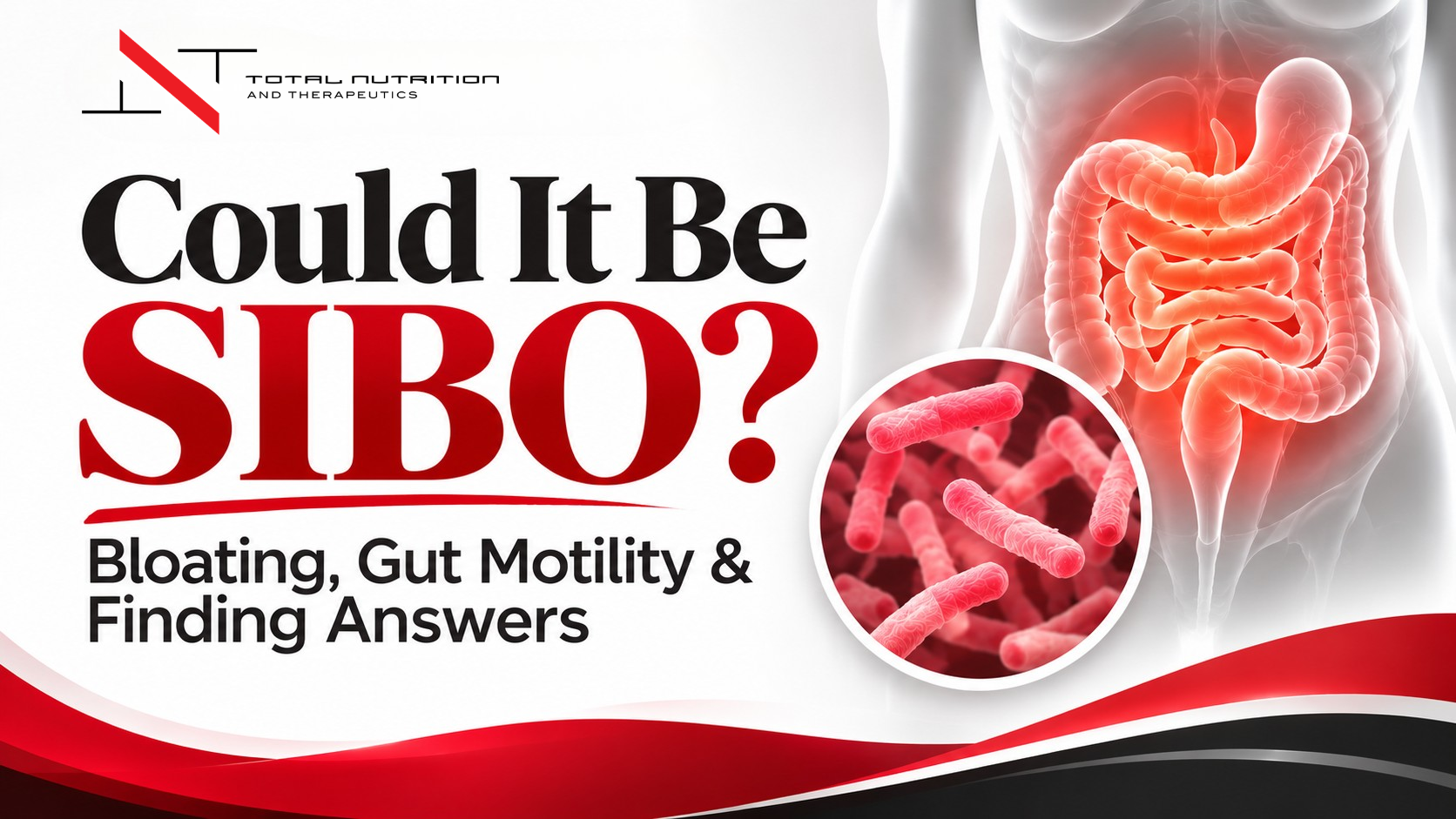
Why persistent digestive symptoms deserve a closer look—even when you’re eating healthy foods.
Have you ever finished a meal that you thought was healthy, only to find yourself feeling bloated, uncomfortable, or frustrated by digestive symptoms?
Maybe you’ve eliminated gluten, dairy, or other foods. Perhaps you’ve tried probiotics, digestive enzymes, or different diets. Yet the bloating, constipation, diarrhea, or abdominal discomfort continues.
And sometimes, despite everything you’re experiencing, you’re told that your test results look normal.
At Total Nutrition & Therapeutics (TNT), we believe persistent symptoms deserve thoughtful investigation. Rather than simply asking how to manage discomfort, we want to understand what may be contributing to it.
In a recent episode of the Synergee Podcast, Lori Esarey and Kelly Englemann welcome Shivan Sarna, author of Healing SIBO, for an important conversation about small intestinal bacterial overgrowth (SIBO), gut motility, digestive testing, and why finding answers isn’t always straightforward.
Watch the Podcast: Could It Be SIBO? Bloating, Gut Motility & Finding Answers with Shivan Sarna
SIBO stands for Small Intestinal Bacterial Overgrowth.
Our digestive tract naturally contains trillions of microorganisms that contribute to digestion, immune function, and overall health. However, the location and activity of these microorganisms matter.
The small intestine is responsible for much of our nutrient digestion and absorption. When excessive bacteria accumulate in this area, they can ferment carbohydrates and produce gases that contribute to uncomfortable digestive symptoms.
Common symptoms associated with SIBO include:
These symptoms are not exclusive to SIBO. Irritable bowel syndrome (IBS), food intolerances, constipation, celiac disease, and other gastrointestinal conditions can cause similar complaints.
The important question isn’t simply whether you have bloating. It’s why you’re experiencing it.
One of the most interesting aspects of SIBO is its relationship with gut motility.
We often think about digestion in terms of the foods we eat and the enzymes needed to break them down. But digestion also depends on coordinated movement throughout the gastrointestinal tract.
Between meals, the small intestine has a pattern of muscular activity called the migrating motor complex (MMC).
Think of the MMC as a housekeeping system that helps move residual food particles, secretions, and bacteria through the small intestine.
When this process is impaired, bacteria may be more likely to accumulate in the small intestine.
Several factors can affect gastrointestinal motility, including medications, certain medical conditions, prior infections, and structural changes within the digestive tract.
This helps explain why focusing exclusively on eliminating bacteria may not address every contributing factor.
If impaired motility is part of the problem, it deserves attention as part of a comprehensive evaluation.
One of the most frustrating experiences for people struggling with digestive symptoms is discovering that nutritious foods can sometimes make them feel worse.
Vegetables, fruits, and other fiber-rich foods are important components of a healthy dietary pattern. However, certain carbohydrates can be fermented by intestinal microorganisms, potentially increasing gas and bloating in susceptible individuals.
This doesn’t necessarily mean those foods are unhealthy or that they need to be eliminated permanently.
It means that digestive tolerance depends on more than nutritional quality alone.
Some individuals may benefit from a temporary, carefully structured dietary approach while investigating their symptoms.
But restrictive diets come with important considerations.
Over time, eliminating too many foods may reduce dietary variety, make adequate nutrition more difficult, and create unnecessary anxiety around eating.
At TNT, we believe nutrition should support healing and long-term resilience—not become an endless list of foods you’re afraid to eat.
When SIBO is suspected, clinicians may consider breath testing as part of the evaluation.
Breath testing typically measures gases produced by intestinal microorganisms after a person consumes a specific test substrate, such as glucose or lactulose.
The gases most commonly measured include hydrogen and methane.
Hydrogen production can be associated with bacterial fermentation, while elevated methane is often linked with constipation and a condition known as intestinal methanogen overgrowth (IMO).
Methane-producing organisms are archaea rather than bacteria, which is why IMO is distinguished from SIBO.
Breath testing can provide useful information, but it also has limitations.
Results may be influenced by intestinal transit time, preparation before testing, and the type of substrate used. A positive or negative breath test should not be interpreted in isolation.
A thorough evaluation considers symptoms, medical history, medications, bowel patterns, and other possible explanations.
Testing should help guide clinical decisions—not replace clinical judgment.
Probiotics are frequently recommended for digestive wellness, but their effects are not the same for everyone.
Different probiotic strains have different properties, and research findings vary depending on the condition being studied.
For someone experiencing significant bloating or suspected SIBO, adding probiotics without understanding the underlying situation may not produce the desired results. Some individuals report increased gas or discomfort.
That doesn’t mean probiotics are inherently harmful or should always be avoided.
It means that the right intervention depends on the individual, their symptoms, and the clinical context.
The same principle applies to digestive supplements, antimicrobial therapies, and elimination diets.
More isn’t always better, and what works for one person may not work for another.
Digestive health is influenced by more than bacteria and food.
In the podcast, the discussion also explores how abdominal surgery, adhesions, and pelvic floor dysfunction may contribute to ongoing digestive difficulties.
Prior abdominal surgery can sometimes lead to adhesions, which are bands of scar tissue that may alter normal anatomy or intestinal movement.
Pelvic floor dysfunction can interfere with coordinated bowel evacuation, contributing to constipation, incomplete emptying, and abdominal discomfort.
These factors are important because persistent constipation or bloating may not respond fully to dietary changes or supplements alone.
Depending on symptoms and history, additional evaluation by a gastroenterologist or pelvic floor specialist may be appropriate.
Understanding the broader digestive picture helps avoid repeatedly treating symptoms without identifying contributing factors.
SIBO treatment depends on the clinical findings and suspected underlying contributors.
A medical treatment plan may include targeted antibiotics when appropriate, evaluation of medications that affect motility, management of constipation, and nutritional strategies to support symptom control.
Equally important is considering factors that may increase the likelihood of symptoms returning.
For example, if a person has impaired intestinal motility, an underlying medical condition, or a structural issue affecting digestion, addressing those factors may be an important part of long-term management.
Not every person with bloating needs SIBO treatment, and not every person with a positive breath test requires the same approach.
A comprehensive strategy should balance symptom relief, nutritional adequacy, and the need for further medical evaluation.
At Total Nutrition & Therapeutics, our philosophy has always been to look at the whole person.
Digestive symptoms can intersect with nutrition, metabolic health, medications, stress, sleep, and many other aspects of wellness.
When someone experiences persistent bloating or digestive discomfort, we believe it’s important to ask thoughtful questions.
What is happening with bowel regularity and gut motility? Are there dietary patterns or medications that may be contributing? Is further gastrointestinal testing appropriate? Could another condition be responsible for the symptoms?
These questions help guide a more individualized conversation.
Our goal is not simply to recommend another supplement or another restrictive diet.
It’s to help clients better understand their health and work toward practical, sustainable solutions.
Perhaps one of the most meaningful messages from this Synergee Podcast episode is that people living with persistent digestive symptoms deserve to have their concerns taken seriously.
Bloating, constipation, diarrhea, and abdominal discomfort can interfere with daily activities, social experiences, food choices, and quality of life.
And being told that everything looks normal doesn’t always explain why someone continues to feel unwell.
If you’re struggling with persistent digestive symptoms, don’t assume you simply need to live with them.
Ask questions. Seek an appropriate evaluation. Work with healthcare professionals who are willing to explore possible contributing factors and explain your options.
Your symptoms are worth understanding, and your digestive health deserves more than guesswork.
In this episode, Lori Esarey and Kelly Englemann sit down with Shivan Sarna, author of Healing SIBO, to explore the challenges of persistent digestive symptoms and the importance of finding answers.
Watch “Could It Be SIBO? Bloating, Gut Motility & Finding Answers with Shivan Sarna” on YouTube
At Total Nutrition & Therapeutics, we believe in helping clients understand the connections between nutrition, digestion, metabolic health, and overall wellness.
If you’re experiencing ongoing bloating, constipation, diarrhea, or other digestive concerns, our team can help you explore a personalized approach and determine when additional medical evaluation may be appropriate.
Stop managing symptoms. Start mastering your health.
Connect with TNT to learn more about our individualized nutrition and wellness services.
Medical Disclaimer: This article is intended for educational purposes only and is not a substitute for individualized medical advice, diagnosis, or treatment. Persistent digestive symptoms should be evaluated by a qualified healthcare professional. Seek prompt medical care for severe abdominal pain, persistent vomiting, gastrointestinal bleeding, or other concerning symptoms.



Ready to start your journey with Total Nutrition and Therapeutics?


 Visit Store